

Kipi, the Quechua-speaking robot
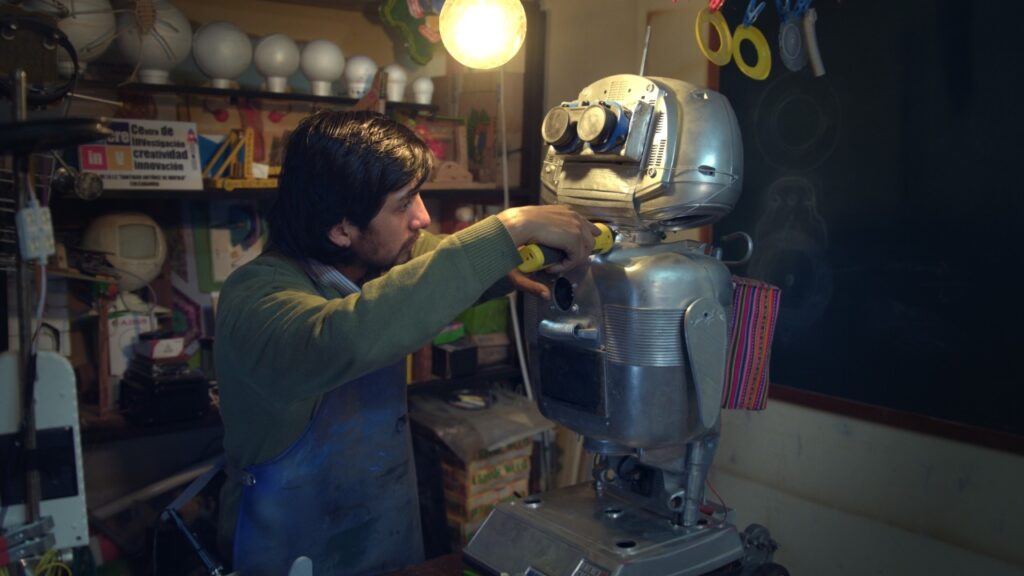
Kipi is the first Quechua-speaking robot, programmed with the school curriculum to reach elementary students in rural areas of Huancavelica where children still cannot get to a school. Kipi plays videos through its eyes, answers the children’s questions, and even sings.
Story
In 2020, schools around the world closed because of the COVID-19 pandemic and moved to online classes over the internet and TV. But in Peru’s poorest regions, where many families have no internet, no computer, and often not even a smartphone, online education was out of reach. Huancavelica is one of those regions.
A local teacher refused to accept that. When Walter Velasquez saw that his students could not keep studying with the schools closed, he decided to build a robot to reach the ones who needed him most. That is how Kipi, the Quechua-speaking robot, was born.
How does it work?
Kipi is made from recycled materials and runs on solar power. It comes preloaded with the school curriculum, so Walter can hold the children’s attention while they keep up with their elementary studies. What began as a single Quechua-speaking robot has since grown into a programmable, 3D platform that speaks at least eight of Peru’s native languages, including Quechua variants and Ashaninka.
Walter Velasquez, the teacher
Walter is an elementary teacher and a computer and design technician, with a background in biology and chemistry and a postgraduate degree in Educational Sciences. Walter built his first robot himself, with his own money and the help of his students and neighbors. Because of the region’s geography, he first traveled on foot to remote homes in the mountains of Huancavelica, with Kipi carried on the back of a llama or a donkey.
Walter’s work has been recognized well beyond Huancavelica. He was named “Promoter of Sciences in Peru” by the National Council of Science and Technology and honored by the Peruvian Parliament. But what keeps him going is simpler: improving the robots, reaching more communities, and seeing the children learn and light up alongside Kipi.
Working together with the Spirit of Big Five Foundation
Although there is still a long way to go, Walter’s vocation is clear: bringing quality, inclusive education to the children of his native Huancavelica, one of the poorest regions in the country, where many grow up in a difficult, often violent environment. In places like these, access to real education changes the paths open to a child. That is exactly the gap Kipi helps close, and why we chose to support it.
As Big Five’s operator in Peru, we run the trips their travelers take here, and those journeys fund Kipi through the Spirit of Big Five Foundation. Through this partnership, in 2021 Walter developed a smaller version of the robot, Kipi Mini, which carries only the features essential for learning.
Today, Kipi is growing into a national project. The current plan brings Kipi Mini into 10 rural schools across 9 regions of Peru, aligned with the UN goals for quality education and gender equality. In 2024, Walter and the foundation were recognized at Virtuoso Travel Week, and the regional government of Huancavelica formally called for the initiative to be scaled up.
How can you help?
When you travel with us, you support Walter Velasquez and the hundreds of children learning through Kipi in Quechua, the most widely spoken indigenous language in Peru. If you would like to support the project through your trip, or help directly, write to us at info@peruviansoul.com and we will be glad to help.



Stories from the Road
Social commitment
Thoughtful Travel Notes
Guides

How to Experience Peru Well
Travel Tips

Travel Better in Peru
Destinations